


“What does it take to deliver a working HPC service?”
This year’s Alces Flight Challenge
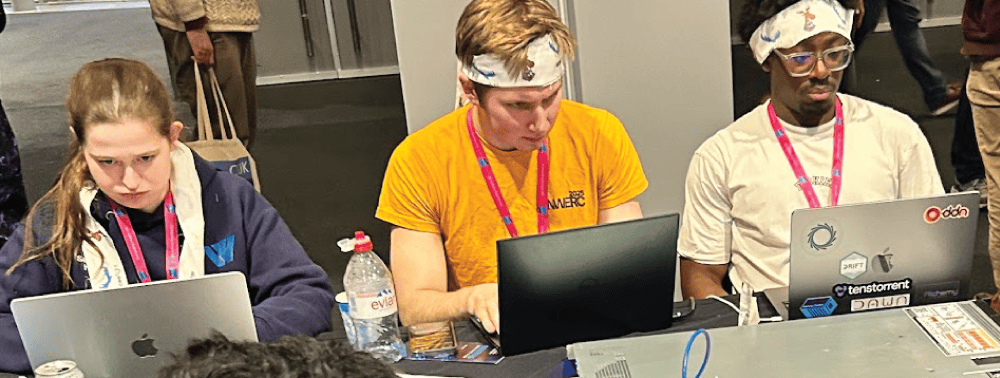
At CIUK 2025, Alces Flight offered this year’s Student Cluster Challenge teams the chance to find out – not in theory, but in practice – how an HPC service really works. Armed with real hardware, open-source tools, and limited time, students undertook tasks to build and operate a fully functional HPC service from the ground up.
This year’s challenge marked a deliberate shift in focus. After an online qualification round that explored the use of existing local and national HPC services, the in-person competition centred on service delivery: standing up a cluster, supporting users, running workloads, and explaining how and why they built the service. All under real-world constraints.
Read on or jump to our white paper
Real Hardware, Real Responsibility
Alces gave each team a single VM server and asked them to turn it into a four-node cluster with a shared HPC environment. That meant teams had to do everything from powering on the system to configuring networking, deploying the OS, running jobs, introducing improvements, and ultimately putting the service into production.
To succeed, teams had to attract and support multiple users – both from the competitor pool and from the wider CIUK attendee and exhibiting community.
To accelerate deployment without hiding complexity, teams built their clusters using GHPC, Alces Flight’s open-source HPC/AI stack deployment framework. GHPC provided a reproducible starting point while ensuring teams remained responsible for configuration, operation, and troubleshooting – just like in production environments.
From Cluster to Service
Once online, each team’s cluster behaved as a live service rather than a static system. Teams ran scheduled jobs through Slurm, enabled containerised and graphical workloads, installed applications, and onboarded real users onto their platforms.
Abstract benchmarks didn’t measure the success of this challenge; they only assessed whether the system worked for the users.
Learning That Transfers
By the end of the challenge, students hadn’t just built a small supercomputer – they had experienced the realities of operating one. Managing users, setting policies, supporting workloads, and communicating system capabilities are just as important as the initial deployment.
That was the goal of our contribution to the CIUK Student Cluster Challenge: give students real systems, real responsibility, and space to grow. Because, as we all know, the best way to learn how HPC works… is to run it.
Want the Technical Details?
We’ve published a short technical white paper outlining the architecture, operational approach, and design decisions behind our contribution to this year’s challenge – including how we used GHPC to deliver reproducible, service-focused HPC environments.
The paper also examines how open, operationally transparent principles scale to the management and evolution of larger HPC platforms.
Read our technical white paper to explore all these considerations in more detail.