

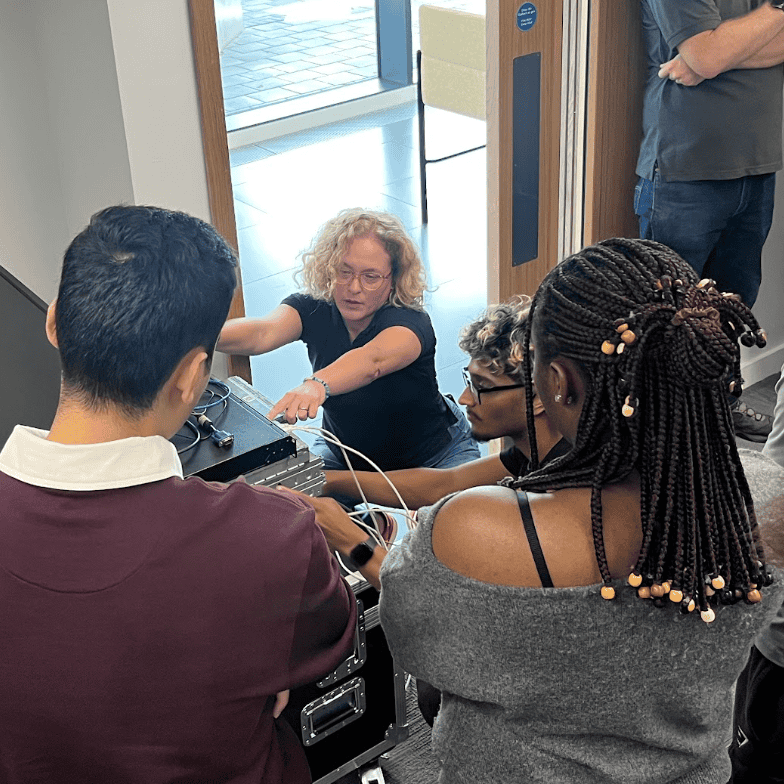
Real HPC hardware, first Slurm jobs, Mandelbrot experiments and a little machine learning. Here’s what happened when Sustainable Reality travelled to four UK universities.
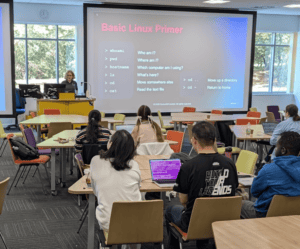 Four universities. Eight days. A working HPC cluster, a collection of cables, and 181 people ready to explore.
Between 26 September and 3 October, the Sustainable Reality HPC & AI Roadshow travelled across the UK, bringing together Alces Flight, colleagues from Alces and ConcertIM, and university research computing teams for four days of hands-on HPC.
Of the 181 participants who joined us, 122 indicated during registration that this would be their first experience with HPC.
Our plan? Start with the physical hardware, move into Linux and Slurm, and then let participants explore computational workloads. We wanted people to see what goes into a supercomputer, get something running on one, and perhaps discover an interest they hadn’t expected.
Of course, first we had to get the cluster around the country.
Four stops, plenty of curiosity
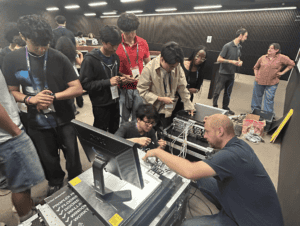 We began at University College London on 26 September, working with STEP-UP to welcome a group that included students aged 16 to 18. For many, this was their first encounter with HPC hardware. They helped connect the cluster, investigated the equipment and, when the system powered on, gave it a round of applause. Not a bad start to the Roadshow!
From London, we headed to Queen’s University Belfast, where NI-HPC joined us for the second event on 30 September. As at every stop, the university’s research computing specialists were on hand to help participants navigate the activities and answer questions.
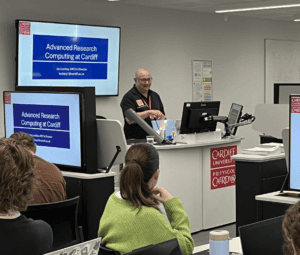 Our next stop was Cardiff University on 2 October. The cluster was assembled again, with participants getting hands-on with the components before moving into Linux, Slurm, and computational exercises.
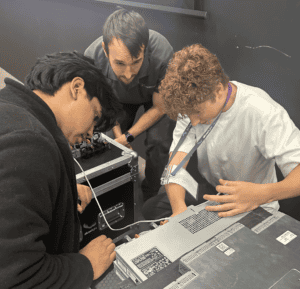
We finished at the University of York on 3 October, where opening a compute node prompted people to gather around and investigate what was inside. Sometimes the simplest way to start a conversation about HPC architecture is to take the lid off a server.
Different locations, different participants, and plenty of questions along the way. Throughout the Roadshow, departmental leads, Research Software Engineers and research IT colleagues helped us adapt the activities to the people in each room.
A new job for some familiar hardware
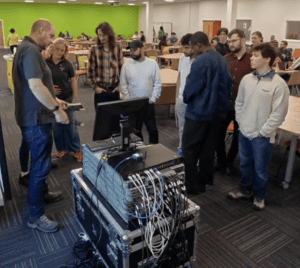 At the centre of Sustainable Reality was a working HPC cluster that had already completed its original deployment in research computing. Now it had another job.
Rather than putting the equipment aside, we brought it into classrooms and invited people to help assemble it. Participants handled compute nodes, connected networking, and explored how the components fit together.
People asked about ports, cabling, and the differences between Ethernet and Omni-Path. Those might sound like small details, but they’re the beginnings of much bigger conversations about interconnects, bandwidth, latency and network architecture.
We weren’t expecting anyone to master cluster design in a morning. We wanted them to get close enough to the technology to start asking questions. And there’s a sustainability story in that, too. The cluster had already supported research. Its next contribution was helping people discover the infrastructure behind it.
From cables to code
The physical cluster was only the beginning.
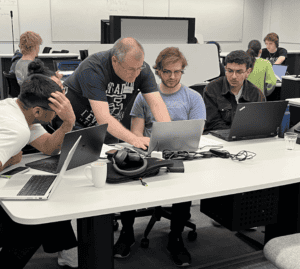
For the computing activities, participants connected to a prepared environment, where they learned their way around Linux, worked with files and submitted jobs using Slurm.
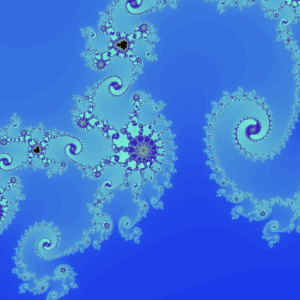
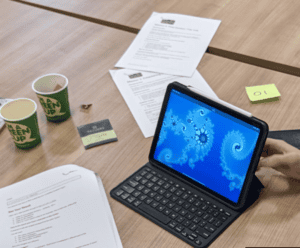 Then we introduced the Mandelbrot Set.
With Python scripts and a set of starting regions, participants could generate fractal images, change coordinates, experiment with colours and investigate what happened when they modified the code.
Some were getting comfortable with their first commands. Others were soon exploring beyond the instructions. We saw people sharing ideas, troubleshooting together and even explaining the mathematics behind the Mandelbrot Set to one another.
We also offered a final AI exercise using TensorFlow and GPU resources to cap off the day.
 The task was to train a machine learning model using Fashion-MNIST, a dataset of clothing images, then use the trained model to predict images it hadn’t trained on.
Unlike the relatively quick visual feedback from the Mandelbrot activity, training the model took time. Quite a bit of it, in fact.
That was part of the experience. AI training doesn’t happen by magic. Behind the predictions are data, mathematical calculations, software, job scheduling and computing resources. The exercise offered a first look at training versus inference, and why GPUs can be useful for particular workloads.
Our aim with each exercise was to nudge participants towards exploration. We wanted everyone to have a starting point, with room to go further if inspired.
The people who made it happen
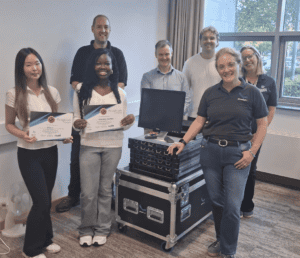 Moving hardware between four universities was one challenge. Delivering useful, welcoming activities for people with very different experience levels was another.
Neither would have been possible without the people involved.
Colleagues across Alces and ConcertIM worked alongside departmental leads, Research Software Engineers and research IT teams at each university. Our hosts contributed far more than rooms and tables. They brought expertise, local knowledge and the ability to help participants when an unfamiliar command or an unexpected result raised another question.
A huge thank you to University College London and STEP-UP, Queen’s University Belfast and NI-HPC, Cardiff University, and the University of York for making the Roadshow possible.
 And thank you to everyone who joined us, whether you came with experience to share or were encountering HPC for the first time.
What happens next?
Sustainable Reality was never intended to end with the final Slurm job.
Throughout the Roadshow, we shared opportunities to continue exploring HPC, including the CIUK Student Cluster Challenge, student programmes, volunteering and other community activities.
We’re also hoping to bring together some of the Mandelbrot images generated during the events for a collective Art of HPC 2027 submission.
 There’s plenty for us to reflect on as we consider what Sustainable Reality might look like in the future. But first, a moment to appreciate what everyone achieved together.
Four universities, 181 participants, a great deal of collaboration and a cluster that’s found a rather good second career.
Thank you for making Sustainable Reality 2026 happen.
Interested in getting involved?
Sustainable Reality was made possible through collaboration, and we’d love to hear from others who share our interest in making HPC more accessible.
Whether you’re interested in supporting future outreach activities, exploring a partnership or simply exchanging ideas, get in touch with the Alces Flight team. We’d be happy to start a conversation.